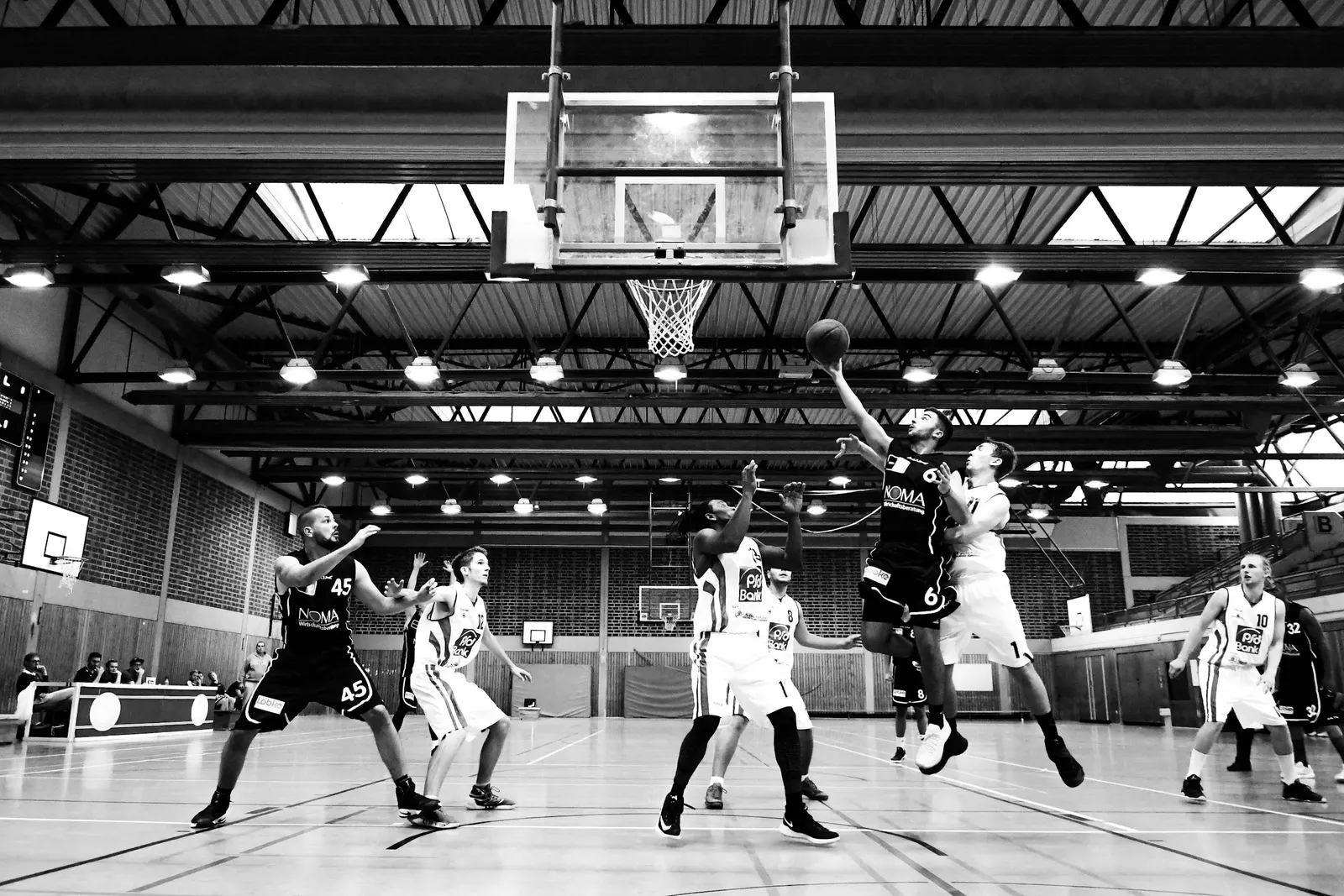
What Basketball Scouts Look for in a Player
A scout doesn't fill out a sheet with points per game and throw out a yes or no. What he looks at is whether a player can sustain his level under pressure, improve in real time, and fit into a game system different from the one he knows. The best talents in Latin America often lose opportunities not because of lack of skill, but because they don't understand what the person observing them is really looking for.
Defense: the first filter
Defense is the first test of professionalism a scout sees. It's not glamorous, and that's why many young players avoid it during training, but in an observation session, a player who commits defensively from the first minute sends a clear message: I want to win, not just score.
Scouts specifically look at:
- Initial positioning: Is the player where he should be before the play starts, or does he arrive late reacting?
- Consistency: Does he defend the same in the first quarter as in the fourth quarter?
- Tactical intelligence: Does he understand when to switch, when to pressure, and when to respect space?
- Recovery: After making a defensive mistake, does he get frustrated or immediately move on to the next play?
A forward who defends solidly but scores 8 points has more market value for top programs than a point guard who scores 20 but relaxes on defense.
Basketball IQ
This is what separates a promising player from one with real projection. It refers to the ability to read the game without someone yelling from the bench what to do.
It includes:
- Recognizing defenses in real time and adjusting the offense without explicit verbal communication.
- Identifying advantages (your defender is far away, your teammate has numerical superiority) and executing.
- Understanding when taking a bad offensive option is better than forcing the good one.
- Knowing where to position yourself without the ball to be available for the next action.
A point guard who passes to a teammate in good position gains points. A point guard who avoids the ball when he feels pressure loses confidence. Scouts notice the difference in a game, not necessarily in a school practice.
This is difficult to measure in numbers. That's why tools like video analysis on sports platforms (or simply sharing clips of your best decisions, not just your best baskets) help scouts form a more complete opinion.
Athletic projection and capacity to improve
A scout knows that a 16-year-old player is not his final version. The question is: is there room to grow?
It's not just about height. It's about:
- Versatility: Can he play more than one position? Can he defend up and down?
- Work on weaknesses: If he has a poor shot, is he improving it? Does he deliberately practice what doesn't come naturally?
- Receptiveness: Does he take feedback without defensiveness? Does he adjust in the next training session?
- Learning speed: When he introduces a new movement (pivot, pick and roll executed differently), how many repetitions does he need before it becomes automatic?
A player who is already perfect in his current role has less future value than one who is imperfect now but is clearly going to improve.
Mentality under pressure
Scouts can't know how a player will react in a playoff final until he's there. But they do see indicators in competitive training sessions and regular season games.
They seek answers to: Does he play differently when there's a crowd? Does he shut down when things aren't working? Does he make worse decisions when he's tired or does he maintain his level of thinking?
One bad game doesn't say much. But a bad game followed by another where the player adjusts his approach and performs better does speak volumes. The same goes for a good game followed by a regular one: it shows that he doesn't depend on emotional factors but on conscious execution.
Things scouts DON'T prioritize as much
It's good to clarify what's not on the main radar:
- Social media popularity: It can help commercially later, but it doesn't affect your level of play.
- Championships won at age 14: Individual talent matters more than the local tournament trophy. A scout prefers an MVP of a competitive league over a champion of a weak league.
- Current age limits: If you're 17 and small, but your coordination and decision-making are at a 20-year-old's level, that counts.
- Comparisons with professionals: Saying 'I'm like Luka Doncic but a defender' doesn't add anything. Let him see it.
If you're a parent, coach, or the player himself, Smidrat Hub offers tools to document your performance and share it in a way that scouts can review what really matters: decisions under pressure, defensive consistency, and how you grow from one game to the next.
What doesn't change from one level to another
A scout from a professional club looks for exactly the same thing as one from a European university: mentality, consistency, game intelligence. What changes is the level of execution expected. At 15 you can be technically imperfect but impeccable defensively. At 22, both are expected.
That's why the path is clear: work on your defense today, understand the game tomorrow, improve one weakness each week, and maintain the mindset that every game is an evaluation. Don't do it because there's a scout watching. Do it because that's how you play seriously.
Frequently Asked Questions
Does a good scoring average guarantee that a scout will be interested?
No. Many young players score well in weak leagues but don't land a contract because they don't play defense, make poor decisions with the ball, or aren't positionally versatile. A scout sees the average, but prioritizes how you scored it: against what defenses? How many of those points were gifts from opponent defensive errors? Did you improve your three-point shot month after month?
What age is ideal to catch scouts' attention?
It depends on the level. Scouts from European universities watch from U16-U17. NBA scouts begin to observe players around U18-U20. But in Latin America, if you're consistently good from U15 onward, there starts to be movement. Age is not a limit if you demonstrate that you're going to improve.
How do I know if a scout is really watching me?
A serious scout doesn't always announce himself. But if you're in an important tournament or your league has international visibility, there will be people taking videos and notes. The important thing is not knowing if they're watching, but playing as if someone is always watching. If the level is real, the scout will appear eventually; if he doesn't, it's because there's something to improve.
Redactor de contenido deportivo en Smidrat.
Compartir